Home Services Portfolio Blog About Us Contact
> services.api()

API Development Services
Other Systems Can Rely On

We design, build, and document APIs — REST and GraphQL services that power mobile apps, connect the tools your business already runs on, and let partners integrate with your product without opening a support ticket for every field.

// what we build

What our API development services cover

An API is a product with its own users: the developers who call it. That's true whether they sit in your company, at a customer, or on the far side of a partner integration. We build APIs to be predictable, documented, and versioned, so integrating with one takes an afternoon rather than a quarter.

REST & GraphQL APIs

Public and internal APIs designed around real use cases — consistent resources, sensible pagination and filtering, and error responses a client can actually act on.

Third-Party Integrations

Payment providers, CRMs, ERPs, shipping, messaging, and accounting systems wired in properly — including the retries, reconciliation, and failure paths most integrations skip.

Mobile & Web App Backends

The API layer behind iOS, Android, and single-page apps: authentication, sync, endpoints that tolerate a bad connection, and push notifications.

Webhooks & Events

Outbound webhooks with signing, retries, and replay, so your customers' systems hear about a change instead of polling you every sixty seconds to find out.

Authentication & Rate Limits

OAuth 2.0, API keys, scoped tokens, rate limiting, and audit logging — access that's quick to grant to a new partner and just as quick to revoke.

Documentation & Versioning

OpenAPI specs, worked examples, sandbox credentials, and a versioning policy that lets the API change without breaking the clients already using it.

// when you need one

When to bring in an API development company

API work tends to arrive from one of four directions, and each one changes what gets built first:

  • There's an app, but no backend. A mobile or web client needs somewhere to authenticate, store data, and run business rules. The API is the product at that point — the screens are the thin part.
  • Customers want to integrate with you. A public API is frequently what closes a larger deal for a SaaS platform: the buyer's team wants your data in their warehouse and their tools, and a CSV export is not an answer.
  • Your own systems don't talk. The CRM, the finance system, and the operational tool each hold part of the truth, and somebody is keeping them in sync by hand every morning.
  • The existing API has become a liability. Undocumented, unversioned, and breaking a client every time it changes — so nobody dares touch it, and it slowly blocks the roadmap.

In the first case we usually build the API alongside the product it serves, as part of a wider web development or mobile build. In the last case the job starts with reading what's there: mapping the current endpoints and their real consumers before proposing a version that can be migrated to rather than swapped in overnight.
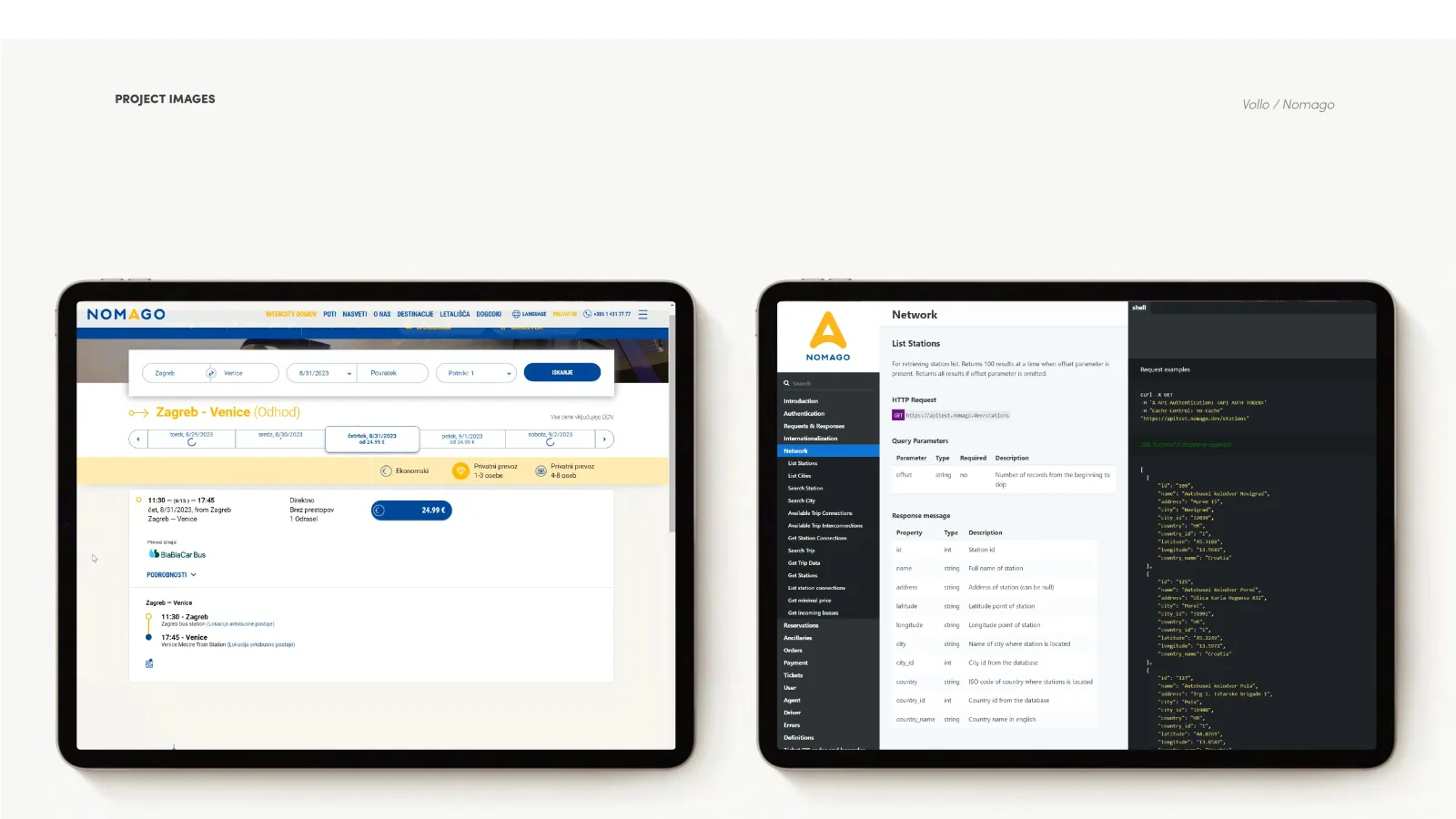

// the stack

The stack we build APIs on

Most of our API work runs on Laravel and PHP, which gives us authentication, queues, rate limiting, and background jobs without inventing infrastructure first. Data sits in MySQL or PostgreSQL; Elasticsearch handles search endpoints that would otherwise flatten a relational query; Redis and queues absorb spikes so response times stay flat under load.

We document with OpenAPI, cover endpoints with automated tests that run in CI, and ship on cloud infrastructure with alerting on latency and error rates — because an API that's slow at 9am on a Monday is, as far as its clients are concerned, an API that's down.

Discuss your API →
Core
Laravel, PHP, REST & GraphQL
Data & Search
MySQL, PostgreSQL, Elasticsearch
Auth
OAuth 2.0, tokens, SSO, scopes
Performance
Redis, queues, caching, rate limits
Docs & Testing
OpenAPI, automated tests, CI/CD
// how we work

From spec to a stable version one

1 · Design the contract

Resources, payloads, and error cases agreed up front and written as a spec the consuming developers can read before anything is built.

2 · Build & test

Endpoints implemented in short cycles, each with automated tests, so the contract and the code never drift apart.

3 · Document & sandbox

Published docs, examples, and test credentials, so client and partner teams can start integrating before launch day.

4 · Ship & monitor

Rollout with rate limits, logging, and alerting — then versioning discipline so later changes don't break existing clients.

// what you get

What a properly built API changes

The difference between an API that was designed and one that accumulated shows up in a handful of concrete places:

  • Business rules live in one place. Pricing, permissions, and validation behave identically whether the request comes from your web app, a mobile client, or a partner's system — instead of being reimplemented, slightly differently, in each.
  • Integrations fail loudly. Retries, dead-letter queues, and alerting mean a broken third-party connection surfaces as an alert on Tuesday, not as a finance discrepancy at the end of the month.
  • Partners onboard themselves. With docs, a sandbox, and self-serve keys, an integration stops consuming your engineers' calendars.
  • Individual systems become replaceable. When each tool connects through a documented interface rather than direct database access, swapping one out is a project rather than a rebuild.

None of this requires a large up-front programme. The usual starting point is a single well-specified API for one product or one integration, built and documented properly, then extended as more systems need to reach it.

// selected work

APIs we've shipped

See the full portfolio →
Need an API built or rebuilt?

Let's design the contract